
Sacred Paris: Churches and Monuments follows the city’s spiritual and civic story through places where faith, power, and art meet in stone and light. From medieval sanctuaries on the Seine to solemn memorials and domed landmarks, the guide traces how Paris has repeatedly reshaped its sacred spaces - preserving tradition, absorbing revolution, and emerging with a layered identity that’s uniquely French.
This guide is for travelers who want more than pretty façades: history lovers, architecture fans, and anyone curious about how a capital remembers itself. Along the way you’ll encounter Gothic engineering at its most daring, stained glass that turns sunlight into a spectacle, and neoclassical grandeur that reflects changing ideas of nationhood, monarchy, and the Republic.
Seen together, these sites reveal a continuous timeline - royal devotion, revolutionary rupture, and modern remembrance - within a compact area that’s easy to explore in a few days. Pairing them turns individual visits into a coherent journey through Paris’s great themes: belief and beauty, ceremony and legacy, and the enduring human desire to build monuments worthy of memory.
Highlights

Gaze up at Notre-Dame’s legendary Gothic towers, flying buttresses, and rose windows - an Île de la Cité icon of coronations and literature, now powerfully reborn through restoration.

Step into a jewel box of Rayonnant Gothic: Sainte-Chapelle’s towering stained glass floods the upper chapel with color, built by Louis IX to enshrine sacred relics.

Marvel at the Panthéon’s grand dome and temple-like columns, then descend to the crypt where France honors its greatest minds - an unforgettable meeting of faith, nation, and ideals.

A cradle of Gothic innovation, Saint-Denis stuns with soaring vaults and radiant glass - then reveals royal tombs that read like France’s history carved in stone.
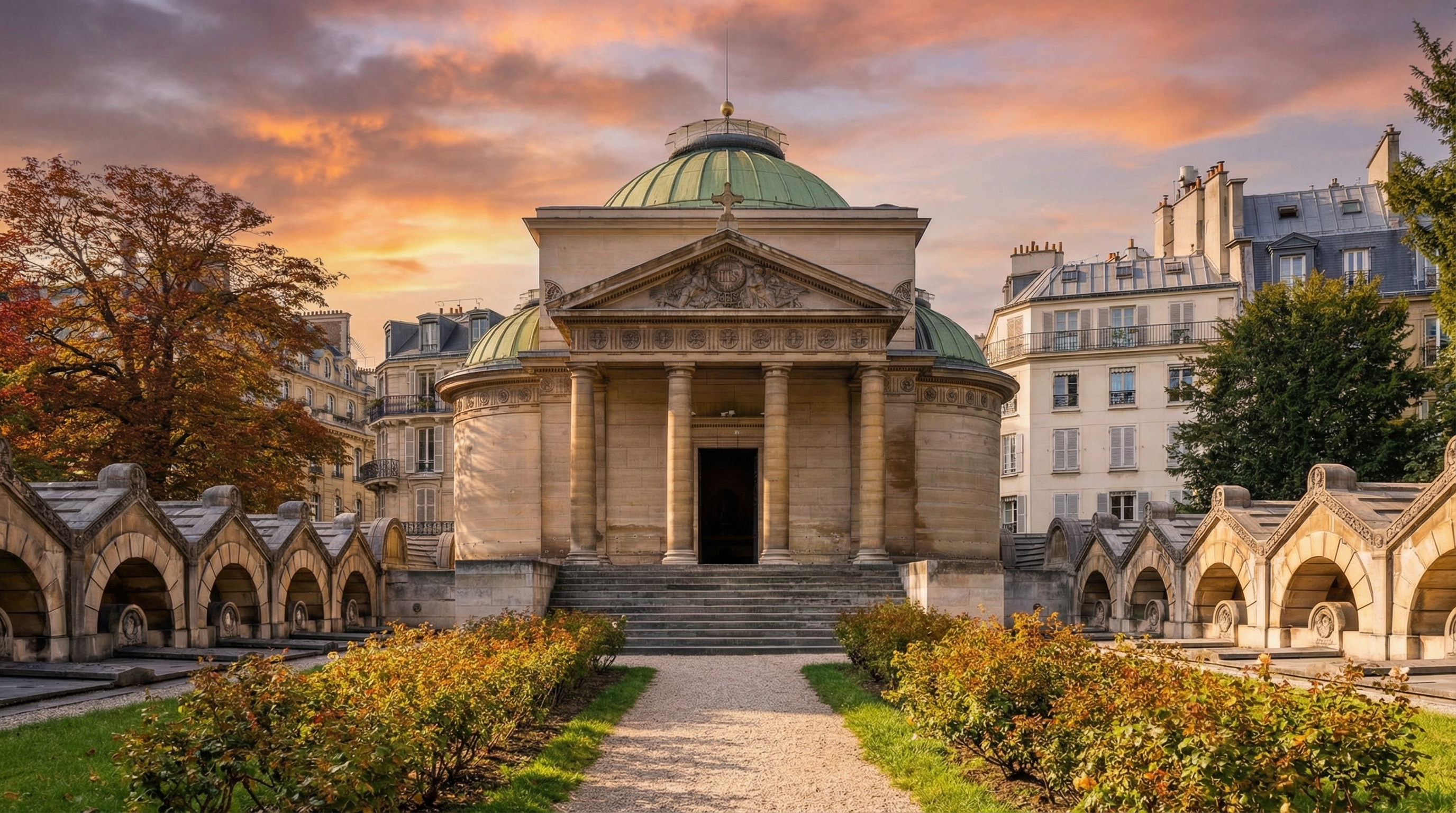
Hidden in quiet gardens, the Chapelle Expiatoire is a solemn neoclassical memorial on the former burial site of Louis XVI and Marie Antoinette - haunting, intimate, and deeply moving.
Suggested Order
Basilica Cathedral of Saint-Denis
Start early with the farthest, most substantial site to avoid later transit fatigue and enjoy the abbey before midday crowds.
Sainte-Chapelle in Paris
Arrive before peak entry lines and catch the stained glass when daylight is strongest for the best color and glow.
Notre Dame Cathedral
A short walk from Sainte-Chapelle, it’s ideal late morning for Île de la Cité ambience with minimal backtracking.
The Pantheon in Paris
Move to the nearby Latin Quarter after lunch for an indoor, steady-paced visit that balances energy after the island sights.
Chapelle Expiatoire in Paris
Finish with this quieter, reflective chapel - typically less crowded and well-suited to a calmer late-afternoon close.
Plan Your Route
Select Attractions
Transport Mode
Getting Around
From Basilique de Saint-Denis take Metro Line 13 (direction Châtillon - Montrouge) to Saint-Michel - Notre-Dame, then follow signs for “Palais de Justice / Sainte-Chapelle” across the Seine onto Île de la Cité.
Exit the Palais de Justice area back toward Boulevard du Palais, then walk east along the river to the parvis of Notre-Dame - keep the twin towers in view as your landmark.
Cross to the Left Bank via Pont au Double and follow Rue Saint-Jacques uphill toward the Latin Quarter; the Panthéon’s dome is visible as you approach Place du Panthéon.
Walk to métro Luxembourg (RER B) and ride to Saint-Michel - Notre-Dame, then transfer to Metro Line 4 to Saint-Lazare; from Saint-Lazare follow signs toward “Boulevard Haussmann / Saint-Augustin” and walk to the chapel gardens.
Best Time to Visit
Notre Dame Cathedral
Best time: early morning (around 8:30 - 10:00) on a weekday
Avoid: midday (11:00 - 15:00) and weekend afternoons, when the parvis and perimeter viewpoints are busiest and any reopened-access/security lines move slowest
Morning visits give you the calmest exterior walk-around and the cleanest light on the west façade before tour groups and day-trippers thicken crowds on Île de la Cité.
Sainte-Chapelle in Paris
Best time: late morning on a sunny day (roughly 10:30 - 12:00), ideally midweek
Avoid: the first hour after opening and rainy/overcast afternoons - opening-hour lines stack up quickly at security for the Palais de Justice, and flat light dulls the stained glass
A bright late-morning slot gives the upper chapel its most vivid “jewel box” glow while beating the heaviest midday queue and security bottlenecks.
The Pantheon in Paris
Best time: after 16:00 (last 1 - 2 hours before closing) on a weekday
Avoid: late morning to early afternoon (10:30 - 14:30), especially Saturdays, when school groups and tour circuits create longer ticket lines and denser galleries
Late-day visits typically mean shorter entry waits and a quieter interior, with warmer light grazing the dome and nave for better photos.
Basilica Cathedral of Saint-Denis
Best time: early opening on a weekday (around 10:00 - 11:30)
Avoid: Sunday late morning (during services) and Saturday afternoons, when access can be limited and the nave/tombs feel most crowded
Arriving near opening lets you see the royal tombs with minimal crowding and better visibility before group visits and service-related restrictions build up.
Chapelle Expiatoire in Paris
Best time: late afternoon (around 15:30 - 17:00), especially midweek
Avoid: lunchtime (12:00 - 14:00) and the final 30 minutes before closing, when nearby office foot-traffic spikes and closing routines can shorten the feel of the visit
Late afternoon is usually the quietest window here, giving you a contemplative, uncrowded circuit through the rotunda and gardens without a rushed atmosphere.
Budget Breakdown
| Attraction | Entry Fee | Booking | Saving Tip |
|---|---|---|---|
Free | — | Entry to the cathedral is free - save on extras by skipping any paid add-ons (e.g., tower/treasury options if offered) and enjoy the exterior viewpoints on the Île de la Cité at no cost. | |
€13.00 | Required | If eligible, use free/discounted admission (EU residents under 26, and other standard French monument exemptions); otherwise, book ahead to avoid time-costly queues. | |
€13.00 | — | Visit during European Heritage Days (typically mid-September) when many major monuments offer free entry. | |
€11.50 | — | Check for free entry on the first Sunday of certain months (often in the low season) and for EU residents under 26 year-old free admission policies at national monuments. | |
€7.00 | — | Use the same eligibility-based reductions as other French national monuments (e.g., EU residents under 26 often free) to cut the ticket cost. | |
Estimated total | €44.50 |
Where to Eat
Practical Tips
Book timed entry online for peak sites; morning slots mean shorter security lines and calmer interiors.
Carry a small coin purse: donations and some audioguides use contactless/coins, and vendors may not break large bills.
Plan stained-glass viewing for bright midday; cloudy late afternoons flatten colors and photos.
Dress in layers and pack a light scarf - stone interiors run cool even in summer, and covered shoulders are appreciated.
Use one Métro day pass and cluster visits by riverbank or Left Bank to avoid backtracking and long walks.
Keep phones on silent and step aside to check maps; locals treat these spaces as active places of worship and mourning.
What to Skip
They’re often overcrowded, aggressively sold, and the commentary is generic - so you pay a premium for a rushed loop you could enjoy more comfortably elsewhere.
Instead: Book directly with Vedettes du Pont Neuf or Batobus online (choose a later-evening slot), or simply walk the Île de la Cité → Île Saint-Louis loop for the best views for free.
Most of it is mass-produced junk at inflated prices that won’t feel meaningful once you’re home.
Instead: For something actually special, buy a print or small art book from a real museum/bookshop (Librairie Galignani, La Procure, or Shakespeare and Company) or pick up a locally made medal/rosary from a reputable church shop when available.
You’re paying extra mainly for a ticket you could reserve yourself, and many tours hustle you through the chapel at the worst lighting/crowd times.
Instead: Reserve a timed entry directly (aim for early morning or late afternoon for better light), then visit the Conciergerie separately only if you’re genuinely interested in Revolutionary history.
You’ll get mediocre food and tourist pricing for a view that’s nicer to admire while walking than while eating a forgettable meal.
Instead: Grab something simple nearby on Rue Mouffetard (casual crêpe/sandwich) or have a picnic in the Jardin du Luxembourg, then come back to the Panthéon for the architecture.
They’re often overcrowded, aggressively sold, and the commentary is generic - so you pay a premium for a rushed loop you could enjoy more comfortably elsewhere.
Instead: Book directly with Vedettes du Pont Neuf or Batobus online (choose a later-evening slot), or simply walk the Île de la Cité → Île Saint-Louis loop for the best views for free.
Most of it is mass-produced junk at inflated prices that won’t feel meaningful once you’re home.
Instead: For something actually special, buy a print or small art book from a real museum/bookshop (Librairie Galignani, La Procure, or Shakespeare and Company) or pick up a locally made medal/rosary from a reputable church shop when available.
You’re paying extra mainly for a ticket you could reserve yourself, and many tours hustle you through the chapel at the worst lighting/crowd times.
Instead: Reserve a timed entry directly (aim for early morning or late afternoon for better light), then visit the Conciergerie separately only if you’re genuinely interested in Revolutionary history.
You’ll get mediocre food and tourist pricing for a view that’s nicer to admire while walking than while eating a forgettable meal.
Instead: Grab something simple nearby on Rue Mouffetard (casual crêpe/sandwich) or have a picnic in the Jardin du Luxembourg, then come back to the Panthéon for the architecture.